
University of Memphis Athletics
Fueling For Performance, Life
Sep 04, 2020 | Football, General
Tiger Bites nutrition program's success explodes since starting in January 2019.
Remember when you were a child and your parents tried persuading you to eat something?
They may have told you peas were green M&Ms. Or bean sprouts were thin angel hair spaghetti noodles.
Don't look now but University of Memphis athletics is adding a nutrit … (shhhh, don't say it).
Okay, okay, Tigers athletics has started a "fueling" program for its student-athletes to help with their nutrition needs.
However, unlike the above scenario, the UofM athletics nutrition program, Tiger Bites, is actually one that many Tigers student-athletes wanted. According to Associate Athletics Director for Student-Athlete Welfare Marlon Dechausay, the drive to pursue a nutrition program was spearheaded by the student-athletes themselves.
"We have a great group of student-athletes here, and they understand that if they want to be the best in their sport, there are certain things that we can do better," said Dechausay, who came to Memphis in the fall of 2018. "It was great that our student-athletes made this push, and it made it a lot easier to move this program along as quickly as we have because they were the ones like, 'hey, we really want this.'"
The program was born in December 2018 out of a meeting between athletics, the UofM's College of Heath Sciences, and within that college, the Human Performance Center. The meeting's first thought was to follow the example of other athletics departments and just provide food, nutritious snacks and smoothies. The group, though, quickly figured out the program's vision was much larger than that.
"This whole thing started in January 2019," said Mary Catherine Schallert, a unit coordinator/clinical associate professor in the College of Heath Sciences and a UofM graduate. "The idea for the nutrition center is what started it. Then, we kind of kept discovering new needs within our student-athlete population.
"The original thought was we could provide some nutrition services. However, it didn't take long for us to get to the realization that what we were trying to provide needed a higher level of expertise, and our students could certainly help."
A driving force that came out of the meeting was not just how to feed the student-athletes, but how could they learn to feed themselves. Enter the Tiger Bites cook-off.
"For me, I didn't just want to provide on-site nutrition for the student-athlete where we hand them something (to eat), they walk out the door and they're fueled for the day," Schallert said. "I want to provide them with knowledge and life skills that they can take forward for the rest of their lives on how to nourish themselves and their future families in helpful ways.
"It didn't take very long in talking with our student-athletes to realize that there was a deficit in knowledge when it came to actually preparing food. A lot of them were grabbing fast food because it is quick and easy. They really didn't have the confidence to know how to prepare food for themselves in their own kitchen."
With the help of Dr. Daniel Greenwood and his staff, UofM volleyball became the first program to hold a cooking seminar that lasted six weeks in the spring of 2019. The seminar ended with a cook-off that patterned itself after a Food Network cooking show. The results?
Positive word about volleyball's cook-off traveled fast.
Softball asked to do a similar program and held its six-week cooking classes in the fall of 2019. Women's soccer was set to do one this past spring, but the pandemic canceled it. According to Schallert, COVID-19 forced the group to think of new ways to reach the student-athletes during the quarantine.
"COVID morphed the cooking series, and we took it to Instagram Live and other virtual cooking demos," Schallert said. "In doing that, we continued to provide student-athletes with a skill set and knowledge to be able to do this themselves for performance and also for life. Some won't continue in athletics once they leave the University of Memphis, so we want to prepare them to do this in their lives."
Another area where the nutrition staff offers assistance is with grocery shopping.
"We've done grocery store tours with student-athletes, and that's been a big success too," said Schallert. "Just walking them through the grocery store and helping them to see what are good deals, what are the best options when looking at energy, hydration, vitamins, minerals, anti-oxidants – all those things that are important for performance. We show them how to find it at store, how much it costs and here's how you use it in your everyday life. That's been really helpful too.
"Instead of giving them the recipe and telling them to make it, we're actually telling them where to find the ingredient in the store. Let's cook it together and show you what the end result can be. Now, you can feel the difference in your performance when you're fueling your body with more whole foods."
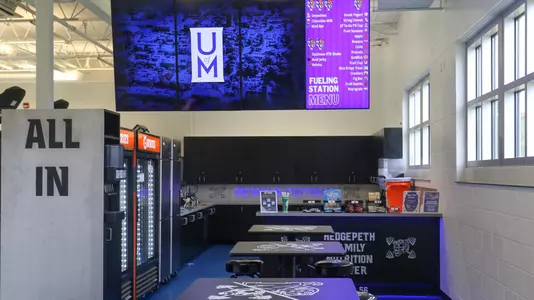
The Tiger Bites program continues to grow and develop and added two major pieces this spring and summer. Just prior to the University closing for the pandemic, the first nutrition center, located in the football weight room of the Billy J. Murphy Complex, was finished. It opened when football activities resumed in June. A second nutrition center is being built for the Olympic sports weight room and is scheduled to open soon.
The second major addition was the hiring of Joe Stanzione, a postdoctoral athletics nutritionist, to head the program. Tiger Bites began with two graduate assistants in 2019, and now Stanzione heads four graduate assistants. Stanzione, who came from Drexel University in Philadelphia, loves the Bluff City, but upon his arrival in July, he found the Memphis "menu" a little different.
"Being from the Northeast, the Philadelphia area, I am getting used to a lot of new foods around Memphis," said Stanzione. "There's a lot more barbecue, a lot more fried things. Even some of my favorite vegetables, I've seen them fried for the first time here. I had never seen fried brussels sprouts until I came here. It's been fun."
After he completed his studies, Stanzione says he wasn't looking for a postdoctoral position. However, Tiger Bites caught his attention.
"The intrigue for me was the research focus (of this program)," said Stanzione. "I just finished my doctorate in nutrition sciences. I'm a former athlete, but what I feel I was lacking was the applied side of things. I found myself running into this crossroad of whether to stay on the academic side and in research or do I try to venture into the applied within athletics and that would typically be a sports dietician.
"I was looking into a lot of sports dietetics positions and I applied to a bunch. Then I saw this position. I really didn't want to do a postdoc, but the way this one was so interestingly structured, it really was the only way that blended those two worlds together."
Since joining the program, Stanzione has slowly developed relationships with student-athletes, teaching them better habits and putting together meal schedules. Gaining the student-athletes' trust and confidence are key to the program's growth.
"It's a combination of education and working with them," Stanzione said. "I don't expect them to make drastic changes to what they do. There will never be a time when someone comes to my office, and I tell them to only eat this certain stuff. That reality is not sustainable for them.
"However, if there is a behavior that is less than ideal, and I would like them to change, I approach them from an educational standpoint. I try not to demonize good and bad foods because I believe there is an opportunity for all foods as long as the balance is there. Finding that balance for an individual is important.
"They are appreciative so far. It's a new concept to them, having someone behind the scenes thinking about what they're eating, finding times where we can do a better job and providing the fueling station for them."
The UofM football players agree. They not only enjoy the nutrition center, but also the one-on-one attention they receive to help them perform better on the field.
"I wanted to change my body, and I knew nutrition was the way to go," said redshirt junior linebacker Xavier Cullens. "I talked with Joe and I've noticed the changes. This means the world to us. We know this will help us perform better."
Freshman offensive lineman Rodney Newsom agreed, "I wanted to trim and tone my body. I met with him, and he gave me a couple things to do. I followed it, and I started to slowly see my (weight) numbers trickle down. I was like, 'okay, this is working.' I started going to him more and now I'm down to 305. He's been a huge help to me.
"They are doing a good job of teaching us to be disciplined. Once you start your plan, you're not coming off of it because you see it works."
Now that the groundwork for Tiger Bites is in place, where does the program expand? More education and an outreach to more athletic programs.
"The education piece has gone over really well," Dechausay said. "The student-athletes appreciate being heard and are seeing the difference. Now, the future is tweaking the program and making sure we're offering what each student-athlete needs. That's where we want to go."
Schallert added, "We do have big dreams for where we would like to see it. We would like to see a full nutrition department embedded within athletics where every team had dedicated personnel to work with those student-athletes. We would like to be able to train future sports nutrition professionals as well.
"It's a win-win situation when we not only provide a valuable service to our student-athletes, but also train the next generation of sports dietetics practitioners."
Stanzione also sees that as a future goal for Tiger Bites. However, the top goal remains the education of student-athletes so they can use what they learn for life after sports.
"If there is one overarching goal for the program is to empower them to make these choices," Stanzione said. "We give them that knowledge. They can now walk away and feel empowered to make their own choices and they know why. That's probably the most important thing we do. If you have a broad understanding of what you need to do, it can make a huge difference in your overall well-being and health."
They may have told you peas were green M&Ms. Or bean sprouts were thin angel hair spaghetti noodles.
Don't look now but University of Memphis athletics is adding a nutrit … (shhhh, don't say it).
Okay, okay, Tigers athletics has started a "fueling" program for its student-athletes to help with their nutrition needs.
However, unlike the above scenario, the UofM athletics nutrition program, Tiger Bites, is actually one that many Tigers student-athletes wanted. According to Associate Athletics Director for Student-Athlete Welfare Marlon Dechausay, the drive to pursue a nutrition program was spearheaded by the student-athletes themselves.
"We have a great group of student-athletes here, and they understand that if they want to be the best in their sport, there are certain things that we can do better," said Dechausay, who came to Memphis in the fall of 2018. "It was great that our student-athletes made this push, and it made it a lot easier to move this program along as quickly as we have because they were the ones like, 'hey, we really want this.'"
The program was born in December 2018 out of a meeting between athletics, the UofM's College of Heath Sciences, and within that college, the Human Performance Center. The meeting's first thought was to follow the example of other athletics departments and just provide food, nutritious snacks and smoothies. The group, though, quickly figured out the program's vision was much larger than that.
"This whole thing started in January 2019," said Mary Catherine Schallert, a unit coordinator/clinical associate professor in the College of Heath Sciences and a UofM graduate. "The idea for the nutrition center is what started it. Then, we kind of kept discovering new needs within our student-athlete population.
"The original thought was we could provide some nutrition services. However, it didn't take long for us to get to the realization that what we were trying to provide needed a higher level of expertise, and our students could certainly help."
A driving force that came out of the meeting was not just how to feed the student-athletes, but how could they learn to feed themselves. Enter the Tiger Bites cook-off.
"For me, I didn't just want to provide on-site nutrition for the student-athlete where we hand them something (to eat), they walk out the door and they're fueled for the day," Schallert said. "I want to provide them with knowledge and life skills that they can take forward for the rest of their lives on how to nourish themselves and their future families in helpful ways.
"It didn't take very long in talking with our student-athletes to realize that there was a deficit in knowledge when it came to actually preparing food. A lot of them were grabbing fast food because it is quick and easy. They really didn't have the confidence to know how to prepare food for themselves in their own kitchen."
With the help of Dr. Daniel Greenwood and his staff, UofM volleyball became the first program to hold a cooking seminar that lasted six weeks in the spring of 2019. The seminar ended with a cook-off that patterned itself after a Food Network cooking show. The results?
Positive word about volleyball's cook-off traveled fast.
Softball asked to do a similar program and held its six-week cooking classes in the fall of 2019. Women's soccer was set to do one this past spring, but the pandemic canceled it. According to Schallert, COVID-19 forced the group to think of new ways to reach the student-athletes during the quarantine.
"COVID morphed the cooking series, and we took it to Instagram Live and other virtual cooking demos," Schallert said. "In doing that, we continued to provide student-athletes with a skill set and knowledge to be able to do this themselves for performance and also for life. Some won't continue in athletics once they leave the University of Memphis, so we want to prepare them to do this in their lives."
Another area where the nutrition staff offers assistance is with grocery shopping.
"We've done grocery store tours with student-athletes, and that's been a big success too," said Schallert. "Just walking them through the grocery store and helping them to see what are good deals, what are the best options when looking at energy, hydration, vitamins, minerals, anti-oxidants – all those things that are important for performance. We show them how to find it at store, how much it costs and here's how you use it in your everyday life. That's been really helpful too.
"Instead of giving them the recipe and telling them to make it, we're actually telling them where to find the ingredient in the store. Let's cook it together and show you what the end result can be. Now, you can feel the difference in your performance when you're fueling your body with more whole foods."
The Tiger Bites program continues to grow and develop and added two major pieces this spring and summer. Just prior to the University closing for the pandemic, the first nutrition center, located in the football weight room of the Billy J. Murphy Complex, was finished. It opened when football activities resumed in June. A second nutrition center is being built for the Olympic sports weight room and is scheduled to open soon.
The second major addition was the hiring of Joe Stanzione, a postdoctoral athletics nutritionist, to head the program. Tiger Bites began with two graduate assistants in 2019, and now Stanzione heads four graduate assistants. Stanzione, who came from Drexel University in Philadelphia, loves the Bluff City, but upon his arrival in July, he found the Memphis "menu" a little different.
"Being from the Northeast, the Philadelphia area, I am getting used to a lot of new foods around Memphis," said Stanzione. "There's a lot more barbecue, a lot more fried things. Even some of my favorite vegetables, I've seen them fried for the first time here. I had never seen fried brussels sprouts until I came here. It's been fun."
After he completed his studies, Stanzione says he wasn't looking for a postdoctoral position. However, Tiger Bites caught his attention.
"The intrigue for me was the research focus (of this program)," said Stanzione. "I just finished my doctorate in nutrition sciences. I'm a former athlete, but what I feel I was lacking was the applied side of things. I found myself running into this crossroad of whether to stay on the academic side and in research or do I try to venture into the applied within athletics and that would typically be a sports dietician.
"I was looking into a lot of sports dietetics positions and I applied to a bunch. Then I saw this position. I really didn't want to do a postdoc, but the way this one was so interestingly structured, it really was the only way that blended those two worlds together."
Since joining the program, Stanzione has slowly developed relationships with student-athletes, teaching them better habits and putting together meal schedules. Gaining the student-athletes' trust and confidence are key to the program's growth.
"It's a combination of education and working with them," Stanzione said. "I don't expect them to make drastic changes to what they do. There will never be a time when someone comes to my office, and I tell them to only eat this certain stuff. That reality is not sustainable for them.
"However, if there is a behavior that is less than ideal, and I would like them to change, I approach them from an educational standpoint. I try not to demonize good and bad foods because I believe there is an opportunity for all foods as long as the balance is there. Finding that balance for an individual is important.
"They are appreciative so far. It's a new concept to them, having someone behind the scenes thinking about what they're eating, finding times where we can do a better job and providing the fueling station for them."
The UofM football players agree. They not only enjoy the nutrition center, but also the one-on-one attention they receive to help them perform better on the field.
"I wanted to change my body, and I knew nutrition was the way to go," said redshirt junior linebacker Xavier Cullens. "I talked with Joe and I've noticed the changes. This means the world to us. We know this will help us perform better."
Freshman offensive lineman Rodney Newsom agreed, "I wanted to trim and tone my body. I met with him, and he gave me a couple things to do. I followed it, and I started to slowly see my (weight) numbers trickle down. I was like, 'okay, this is working.' I started going to him more and now I'm down to 305. He's been a huge help to me.
"They are doing a good job of teaching us to be disciplined. Once you start your plan, you're not coming off of it because you see it works."
Now that the groundwork for Tiger Bites is in place, where does the program expand? More education and an outreach to more athletic programs.
"The education piece has gone over really well," Dechausay said. "The student-athletes appreciate being heard and are seeing the difference. Now, the future is tweaking the program and making sure we're offering what each student-athlete needs. That's where we want to go."
Schallert added, "We do have big dreams for where we would like to see it. We would like to see a full nutrition department embedded within athletics where every team had dedicated personnel to work with those student-athletes. We would like to be able to train future sports nutrition professionals as well.
"It's a win-win situation when we not only provide a valuable service to our student-athletes, but also train the next generation of sports dietetics practitioners."
Stanzione also sees that as a future goal for Tiger Bites. However, the top goal remains the education of student-athletes so they can use what they learn for life after sports.
"If there is one overarching goal for the program is to empower them to make these choices," Stanzione said. "We give them that knowledge. They can now walk away and feel empowered to make their own choices and they know why. That's probably the most important thing we do. If you have a broad understanding of what you need to do, it can make a huge difference in your overall well-being and health."


Players Mentioned

OL
/ FootballSaturday, April 18
Saturday, April 18
Saturday, April 18
Tuesday, April 14